
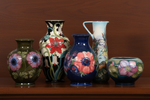
Moorcroft pottery has captivated collectors for more than a century, admired for its rich colours, hand-crafted artistry, and unmistakable tube-lined designs. From its Art Nouveau beginnings to its status as one of Britain’s most prestigious art potteries, Moorcroft’s story is one of craftsmanship, innovation, and enduring appeal.
Origins: William Moorcroft and the Birth of a Legacy (1897–1920s)
Moorcroft’s journey began in 1897, when William Moorcroft, then a young designer at James Macintyre & Co., started producing his own distinctive ceramics. His early work embraced the flowing, nature-inspired forms of Art Nouveau, and he soon developed the technique that would define the brand: tube-lining, a raised slip outline that gives Moorcroft designs their sculptural quality.
The breakthrough came with Florian Ware, a series of floral designs that won a gold medal at the 1904 St. Louis International Exhibition. This international recognition propelled Moorcroft into the spotlight and laid the foundation for its future success.
Expansion, Prestige, and Royal Approval (1920s–1930s)
By the 1920s, Moorcroft’s reputation had grown significantly. Prestigious retailers such as Liberty of London, Tiffany & Co., and Harrods stocked the pottery, cementing its place in the world of luxury decorative arts.
In 1928, Moorcroft received a Royal Warrant from Queen Mary, a mark of excellence that elevated the brand’s status even further. During this period, iconic patterns such as Pomegranate, Claremont, Poppy, Iris, and Eventide emerged—designs that remain highly sought after today.
Post-War Challenges and Modern Revival (1940s–Present)
After William’s death in 1945, his son Walter Moorcroft continued the tradition, introducing new designs while preserving the brand’s hand-crafted ethos. The studio faced changing tastes in the mid-20th century, but by the 1980s and 1990s, Moorcroft experienced a revival as collectors rediscovered the beauty of vintage British pottery.
Today, Moorcroft remains one of the few potteries still producing tube-lined, hand-decorated ceramics using techniques virtually unchanged for over a century.
Why Moorcroft Pottery Is So Collectable
Hand-Crafted Excellence
Every Moorcroft piece is individually tube-lined and hand-painted, resulting in subtle variations that make each item unique. This artisanal approach is a major driver of collector interest.
Iconic Patterns and Early Rarity
Early designs—especially those from 1900–1930—command the highest prices. Patterns such as Pomegranate, Claremont, Poppy, and Iris are particularly prized, especially when bearing William Moorcroft’s signature.
A notable example: a 1913 Pomegranate exhibition plaque sold for £19,200, nearly five times its estimate.
Tube-Lining: The Moorcroft Signature Technique
The raised slip lines create a stained-glass effect when colour is applied between them. This technique is labour-intensive and difficult to replicate, making genuine Moorcroft instantly recognisable.
Clear Markings and Strong Provenance
All authentic Moorcroft pieces carry base markings indicating the year, decorator, and origin. Post-1990 pieces include annual ciphers, while pre-1928 examples may feature William’s hand-painted signature or initials.
Condition and Craftsmanship
As with all ceramics, condition is crucial. Chips, cracks, crazing, or restoration can significantly reduce value. Collectors prize crisp modelling, strong colour, and clean glaze.
Identifying Genuine Moorcroft Pottery
Collectors benefit from Moorcroft’s consistent marking practices:
- Base marks always present
- Painter/tubeliner initials
- Year ciphers (post-1990)
- “Potter to HM The Queen” impressed mark (post-1928)
- Opaque earthenware body—porcelain fakes appear translucent under light
Blank bases are a red flag: genuine Moorcroft is always marked.
Building a Moorcroft Collection
Whether you’re drawn to early Florian ware or modern limited editions, Moorcroft collecting rewards patience and knowledge. Consider:
- Focus on patterns you love—Moorcroft is as much about aesthetic enjoyment as investment.
- Learn the markings—they reveal age, authenticity, and decorator.
- Buy the best condition you can afford—it pays off long-term.
- Explore discontinued patterns—these often rise in value.
- Visit the Moorcroft Heritage Centre—seeing the tube-lining process firsthand deepens appreciation.
Conclusion: A Century of Colour, Craft, and Collectability
Moorcroft pottery stands at the intersection of art and craftsmanship. Its history is rich, its designs iconic, and its collectability


