
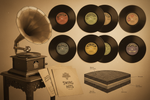
Before vinyl, recorded music spun on 78 rpm shellac discs—brittle, beautiful, and foundational to the modern music industry.
Introduction
Before vinyl became the standard, the world of recorded music spun on 78 rpm shellac discs. Made from a brittle mixture of shellac resin and fillers, these records dominated the first half of the 20th century and brought music into millions of homes. Their distinct sound and tactile charm helped define how people collected, heard, and shared music.
Origins of the 78 record
In the 1890s, Emile Berliner introduced flat disc records, a pivotal shift from Edison’s wax cylinders. As the technology matured, the industry settled on a playback speed of approximately 78 revolutions per minute by the 1910s, largely influenced by early electric motor design and power standards.
Shellac—derived from the lac beetle—was mixed with slate dust, cotton fibers, and other fillers to create a hard, glossy surface suitable for cutting grooves. While durable enough for playback, the material remained relatively brittle, making careful handling essential.
The golden age (1920s–1940s)
From the 1920s to the 1940s, 78s were the primary medium for jazz, blues, classical, and popular music. The format’s capacity—typically around three to five minutes per side—shaped the length, structure, and performance style of early recordings, influencing how songs were written and arranged.
Affordable and widely distributed, 78s helped new genres spread across continents. Record labels built extensive catalogs, and home gramophones turned living rooms into listening spaces, accelerating the growth of a global music culture.
Decline and replacement
By the late 1940s, advances in materials and playback technology ushered in new formats. Columbia introduced the 33⅓ rpm LP for longer works, and RCA popularized the 45 rpm single for radio-friendly tracks, both pressed in more flexible, quieter vinyl.
Compared to vinyl, shellac discs were fragile and more prone to surface noise, especially after repeated plays. As retailers and listeners embraced the improved fidelity and durability of vinyl, production of 78s dwindled through the 1950s and largely ceased in many markets by the early 1960s.
Legacy and collectability
78s preserve performances by seminal artists such as Bessie Smith, Louis Armstrong, and Enrico Caruso, offering a direct window into early recording artistry. For collectors, label variations, scarce pressings, and condition can dramatically influence value and desirability.
Beyond market trends, these discs embody the origins of modern recorded sound—the limitations that shaped music’s form, the technologies that carried it into homes, and the cultural momentum that made listening a shared experience. Their fragility contrasts with their lasting significance, securing 78s a treasured place in music history.


